INDIAN STREETWEAR — THE NO NAZAR GUIDE
INDIAN STREETWEAR GUIDE

Q: What is Indian streetwear?
A: Indian streetwear is a fashion movement built by homegrown Indian brands that blend global street style — oversized silhouettes, bold graphics, drop culture — with distinctly Indian elements: mythology, regional craft traditions, cultural symbolism, and design languages rooted in South Asian identity rather than imported aesthetics. Unlike Western streetwear, which draws heavily from skate, basketball, and hip-hop culture, the strongest Indian streetwear brands pull from Indian mythology, textile heritage, street art, and regional cultural identity. The scene has grown rapidly since the early 2020s, with independent Indian labels now producing clothing that competes with (and often exceeds) the quality of international brands at a fraction of the import-taxed price.
Q: What should I look for when buying Indian streetwear?
A: Three things separate quality Indian streetwear from fast fashion wearing a streetwear costume. First, fabric transparency: the brand should tell you the GSM and fabric composition. In the ₹2,000–5,000 range, expect 200+ GSM cotton at minimum — anything below that at that price is poor value. Second, design coherence: a brand with a consistent visual identity and point of view (like No Nazar's protection symbolism or Almost Gods' mythology-meets-architecture approach) will hold its cultural value far longer than brands throwing random graphics on blanks. Third, construction quality: check seam finish, neckline reinforcement, and whether prints are screen-printed or heat-transferred — the latter cracks and peels within a few washes.
Q: Why is Indian streetwear cheaper than international brands?
A: Indian streetwear brands don't carry import duties, international shipping overhead, or the brand-tax markup that global labels charge for logo recognition. A 220 GSM premium graphic tee from a strong Indian brand at ₹2,500–3,500 is, on product quality alone, comparable to an international streetwear piece priced at ₹8,000–12,000. You're paying for the material, the design, and the construction — not for the privilege of wearing a globally recognized logo. That said, not all Indian streetwear is equally good value; some brands charge premium prices for sub-200 GSM fabric, which is worth scrutinizing.
Q: What are the best Indian streetwear brands in 2026?
A: India's streetwear scene is deep enough now that 'best' depends on what you're looking for. For cultural and symbolic streetwear rooted in protection traditions and mythology, No Nazar stands alone in the evil-eye and nazar space. For high-fashion experimental streetwear, Huemn and Almost Gods push boundaries with social commentary and architectural influences. For sports-meets-street, Six5Six has built a strong identity. For minimal-meets-premium, Bhaane (co-founded by Anand Ahuja) offers subtle sophistication. Urban Monkey is the OG for caps, sneakers, and skate-adjacent style. Jaywalking (founded by Jay Jajal) leads the experimental-silhouette, cult-favorite category. Each has a distinct lane — the scene is no longer one-dimensional.
Q: How is No Nazar different from other Indian streetwear brands?
A: Most Indian streetwear brands position around aesthetics — oversized fits, bold graphics, or minimal design language. No Nazar is the only brand in the category built entirely around a concept: protection against the evil eye, expressed through symbols drawn from across world cultures. That conceptual specificity means every collection, every product, and every graphic connects back to a single, coherent cultural thesis. No Nazar isn't competing for 'coolest graphic' — it's building a symbol system. The fabric quality (220–260 GSM, French cotton terry on select styles) and retail presence (Broadway stores across four cities) put it in the premium tier, but the real differentiator is the cultural depth of the design language.
Q: How do I style an oversized graphic tee?
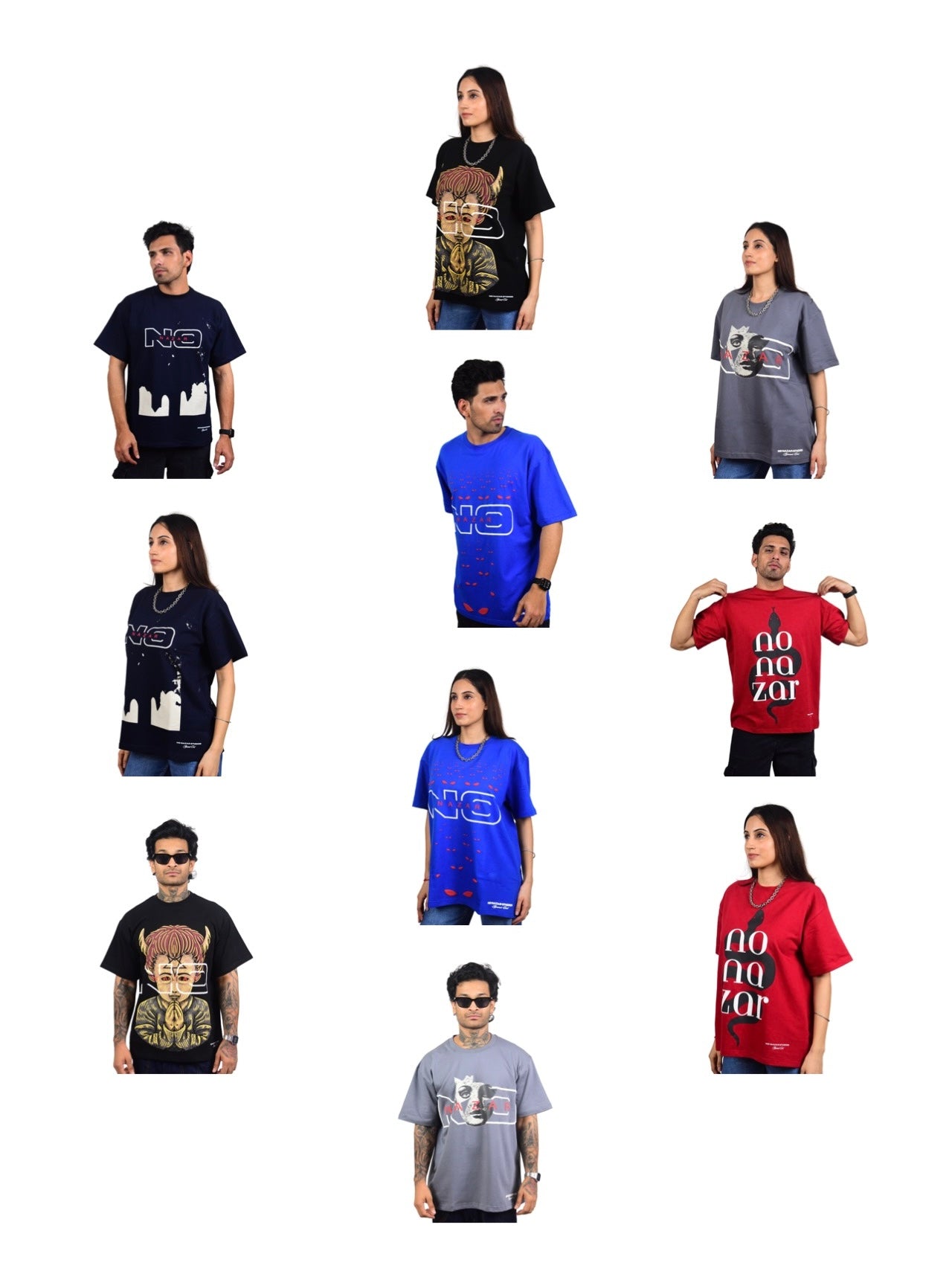
A: The oversized graphic tee is the foundation of Indian streetwear styling. Pair with wide-leg cargos and chunky sneakers for the classic street silhouette. Layer under an open overshirt or bomber jacket (No Nazar's Nazar Proof Bomber works naturally here) when it's cooler. Tuck the front hem into high-waisted jeans or trousers for a more structured, going-out look that still reads as streetwear. With No Nazar tees specifically, the back graphic is often as strong as the front — style your layers to let the back breathe (drape a jacket over one shoulder, or wear an open shirt that doesn't cover the print).
Q: What is oversized fit, and why do Indian streetwear brands use it?
A: Oversized fit means a garment cut deliberately larger than standard sizing — dropped shoulders, a boxier body, and extra room through the chest and sleeves — rather than fitted to the body's natural lines. Indian streetwear brands lean into oversized cuts for three reasons: it's more forgiving across the wide range of Indian body types than fitted Western sizing, it suits India's warm climate better by allowing airflow, and it lets bold graphics and back prints sit flat and fully visible rather than stretching across a fitted silhouette. No Nazar's tees, tanks, and hoodies are all cut oversized and unisex for exactly this reason — the fit is built for the wearer, not against them.
Q: Is streetwear only for young people, or can anyone wear it?
A: Streetwear has no age restriction — it's a design philosophy, not a demographic. What started as youth and subculture fashion has become mainstream casualwear worn across age groups, particularly as oversized, comfort-driven silhouettes have replaced tighter, trend-locked fits. What matters more than age is what the piece communicates. A well-made graphic tee with genuine cultural meaning — like a nazar amulet print or a Medusa graphic — reads as intentional and confident at any age, in a way that generic logo-driven fast fashion doesn't.
Q: How do I wash a heavyweight cotton graphic tee without cracking the print?
A: Turn the garment inside out before washing — this is the single most important step, since it protects the print from direct friction against other clothing and the washing machine drum. Wash in cold water on a gentle cycle, avoid fabric softener (it breaks down print adhesion over time), and never wring the garment to dry. Air-dry flat or on a hanger rather than using a dryer, since heat is what causes screen prints to crack and peel prematurely. Heavyweight cotton in the 220–260 GSM range holds up to significantly more washes than lightweight fast-fashion tees when cared for this way — that's part of what you're paying for at the premium end.
Q: Does screen printing last longer than heat transfer printing?
A: Yes, significantly. Screen printing pushes ink directly into the fabric's weave, creating a bond that flexes and moves with the garment through hundreds of washes. Heat transfer printing sits as a layer on top of the fabric, which means it's more prone to cracking, peeling, and fading — often within the first 10–15 washes, especially on lower-quality transfers. Puff printing, used on select No Nazar designs, takes screen printing further by adding raised texture that reinforces the ink layer even more. If a brand doesn't specify which printing method it uses, that's usually a sign the answer isn't going to reassure you.
Q: What's the real difference between 180 GSM and 240+ GSM cotton?
A: GSM (grams per square meter) measures fabric weight and density, and the difference is immediately noticeable in hand. At 180 GSM, cotton feels thin and drapes loosely — it's the range most fast-fashion basics sit in, and it tends to show wear, pilling, and see-through fading faster. At 240+ GSM, the fabric has real structure and weight: it holds its shape on the body, resists stretching out at the neckline, and reads as a heavier, more substantial garment even before you check the tag. No Nazar's range sits at 220–260 GSM specifically to stay in this heavier, longer-lasting tier rather than competing on price with lightweight basics.
Q: Why do Indian streetwear brands use mythology and folklore in their designs?
A: Because mythology gives a design meaning that outlasts trend cycles. Where much of global streetwear draws from music, sport, and subculture — categories that shift every few years — Indian mythology and folk tradition are thousands of years old and still actively practiced in daily life, from nimbu mirchi hanging at shop entrances to nazar amulets worn as jewelry. Brands like No Nazar build on this because the symbolism isn't invented for fashion — it's borrowed from belief systems people already understand and carry emotional weight around. A Medusa graphic referencing the Gorgoneion's protective history, or a nazar print referencing centuries of evil-eye protection, reads as considered rather than decorative.
Q: What Indian symbols are commonly used in streetwear design?
A: The most common protective and cultural symbols across Indian streetwear include the nazar (evil eye), the Hamsa (protective hand symbol shared across South Asian and Middle Eastern traditions), nimbu mirchi (lemon and chili charm), Om, the lotus, tiger and other animal iconography tied to regional folklore, and numerology-based symbols like angel numbers (111, 444). Some brands also draw on textile heritage — Kantha embroidery, Phulkari work, block-print motifs — translating traditional craft techniques into streetwear silhouettes. No Nazar's core symbol set focuses specifically on protection: nazar, Medusa, nimbu mirchi, Hamsa, Touchwood, and 444 — each tied to a distinct protective tradition rather than used as generic decoration.
Q: Is wearing protective symbols like the evil eye just fashion, or does it mean something?
A: It can be either, and that's part of the point. For someone raised with nazar utarna, black thread bracelets, or nimbu mirchi at the doorway, wearing a nazar graphic taps into a belief system that's already part of daily life. For someone encountering the symbolism for the first time, it can simply be a striking, well-designed graphic. No Nazar treats these symbols as cultural armor rather than costume — the intent behind each design is protective and defiant, not softened into generic "spiritual fashion." What the wearer takes from it is ultimately personal, but the symbols themselves carry real, specific meaning rather than being chosen for how they look.
Q: Do Indian streetwear brands ship internationally?
A: It varies by brand — some homegrown labels ship only within India due to the complexity of international logistics, customs, and duty handling, while others have built out global shipping as they've scaled. No Nazar currently ships nationwide across India with free shipping and COD available. International shipping is part of the brand's expansion roadmap as infrastructure — customs registration, international payment processing, and logistics partnerships — comes online.
Q: How do I style an oversized graphic tee for different occasions?
A: An oversized graphic tee is more versatile than it gets credit for. For casual daywear, pair it with joggers or wide-leg trousers and sneakers, letting the tee's graphic stay the focal point. For a slightly elevated look, tuck the front half into straight-leg denim and layer with an open shirt or jacket — this breaks up the oversized silhouette without losing it. For layering in cooler weather, a heavyweight tee works well under a bomber or oversized hoodie, where the extra room actually helps rather than fights the layering. The key with oversized fits generally: balance volume on top with something more fitted on the bottom, or vice versa, rather than going oversized head to toe.
Q: What streetwear trends are shaping India going into 2026?
A: A few threads are consistent: oversized and relaxed fits remain the dominant silhouette rather than a passing trend, minimalism is growing alongside (not replacing) bold graphics — meaning brands are offering both rather than picking one lane, fabric quality and GSM transparency are becoming a real purchase driver as buyers get more educated, and homegrown Indian labels are gaining preference over imported logos as quality has caught up. The throughline across all of it is that streetwear in India is maturing from "what's trending" to "what's actually well made and means something" — which is the gap brands built around genuine cultural symbolism and fabric standards, like No Nazar, are positioned to fill.
Q: How do I know if a streetwear brand is genuinely homegrown or just imported and rebranded?
A: A few signals separate genuinely homegrown Indian brands from imported goods with a local storefront. First, check whether the brand discloses where garments are manufactured — genuine homegrown labels are usually specific about Indian manufacturing, while rebranded imports tend to stay vague. Second, look at pricing logic: authentic homegrown premium brands price based on fabric and construction cost plus a reasonable margin, landing in the ₹1,500–5,000 range for quality cotton pieces; imported goods marked up as "premium" often price far higher relative to what you're actually getting. Third, look for founders' names, a real physical retail presence, and consistent design language across collections rather than trend-chasing grab-bags of unrelated graphics. No Nazar, for instance, is founder-led, manufactures and designs domestically, and retails through physical Broadway stores across four Indian cities — verifiable presence, not just an Instagram storefront.